Introduction
- As of Jan 2024, rapidplay is a 1 minute penalty for illegal moves
- When adding time to an opponent for an illegal move, you must decrease the increment gained by the offending player
Useful links
Looking up player information
Looking up arbiter information
- ECF Arbiters
- FIDE Arbiters
FIDE Arbiter's Manual 2022FIDE Arbiter's Manual 2024- FIDE Arbiter's Manual 2025
Summary of FIDE Arbiter's Manual Articles
-
Article 1: The nature and objectives of the game of chess
-
Article 2: The initial position of the pieces on the chessboard
-
Article 3: The moves of the pieces
-
Article 4: The act of moving the pieces
-
Article 5: The completion of the game
-
Article 6: The Chessclock
-
Article 7: Irregularities
-
Article 8: The recording of the moves
-
Article 9: The drawn game
-
Article 10: Points
-
Article 11: The conduct of the players
-
Article 12: The role of the Arbiter
Covers things such as penalties, such as warnings, time penalties etc.
Gear (Things to bring to chess tournaments)
Printer
Under no circumstances should you not bring a printer. Printers are the bane of every arbiter's existence. We will always need more printers.
- Tissues
- Scissors (for cutting up paper)
- Paper (A4)
- Sellotape (hanging up signs)
- Duct-tape + tissues (for dampening doors that close loudly)
- AA batteries
- 1000 score sheets
- Pens!!! (Or pencils. Don't expect to get them back)
- Snacks (quiet snacks)
- Blu tack
- (Hand sanitizer)
- Clipboard (A4 size)
- Silent counter
- Ruler (alternative to scissors)
- Measuring tape?
- Black and white printer
- Portable fan
- Extension cable
- Silent mouse
To-get list
Things to get:
- Black and white printer. Laser printer, not inkjet because inkjet is noisy
- Clipboard for keeping track of illegal moves, players that show up late etc.
Daysheet letters
What do the letters on the daysheets mean?
Titles (left of their rating)
c- Candidate Masterf- FIDE Masteri- International Master
Everything else (right of their rating)
c- Converted rating (e.g. from chess.com etc.)e- Estimated grade (e.g. from chess.com, or because they've not played enough matches)u- Unrated (estimate rating)*-- Wildcard player
Inputting results
Marking a round as complete
Go to Home > Schedule. The states are as follows:
- Publish (white): Games are published live. Games are either ready to start or are taking place
- Finished (pink): Games are complete, results have been entered
- Completed (red): Games are completed, and cannot be modified
- Future (yellow): Games haven't started. Pairings haven't been published
A dummy's guide to being a sector
So you've decided you want to be a sector arbiter, and have gotten the role. Congratulations! Being a sector arbiter is no small feat, and all sorts of things can come around to trip you up.
Important links
- 4NCL Rules: https://www.4ncl.co.uk/data/2526/2526_rules.htm
- Team Captain Details: https://www.4ncl.co.uk/data/2526/contact_details.htm
Doing pairings
4NCL is an all-play-all tournament for Div 1, 2, 3b and 3k. For Div 4, it is a Swiss System tournament. Pairings for the upper divisions are done automatically.
Pairings for Div 4 should be done as soon as results are checked and have been marked as Finished. Pairings are done as follows:
-
Find the Div 4 SwissManager file (you can find this in the dropbox)
-
Ensure SwissManager is using the 4NCL License (this is required to use the right pairing system)
-
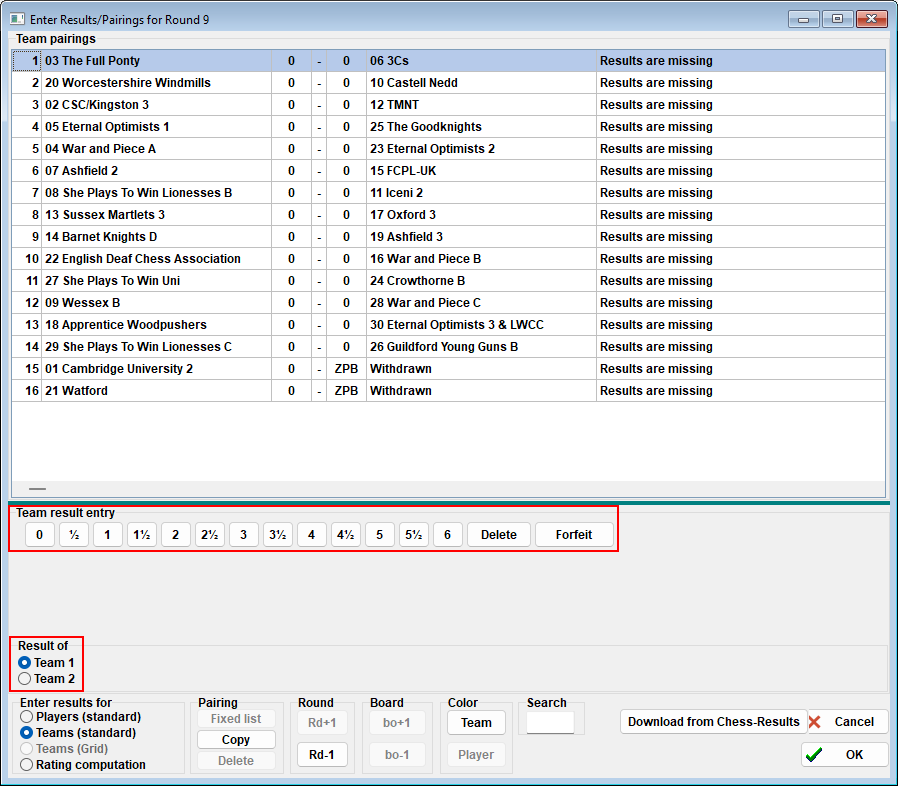
Input results into SwissManager. To do this, use the team result entry buttons. This automatically assumes that points will add up to 6. In the event of a default (or half-point default), you may have to adjust the results of the other team manully, which can be done by checking "Result of Team 2" in the radio box.
-
Generate the pairings, selecting Olympiad mode 2022 as the pairing system
-
Enter the pairings into 4nclresults by going to
Round X > Division 4 > Enter Pairings
Handling reserve substitutions
If a team captain would like to use one of their reserves in replacement for a player on their team, they're allowed to do that even after pairings have been published. If they do:
-
Update the pairings on 4nclresults
-
Print out the new pairings (match sheets and wall sheets)
-
Notify the opposing team captain (this can be done in person, or by sending an email which can be found in the team captain details link at the top of this page)
-
Notify the team captain with the reserve player and the reserve player that there is a 30 minute penalty:
10.5 The clock of the reserve shall be adjusted to show the elapsed time subject to a minimum reduction in available time of 30 minutes.
Do NOT rush the announcements. Make sure you take your time and say everything that has to be said. It's more important to say everything than kick off just because of time.
-
Hi
-
Names of arbiters
-
Toilet locations
-
Fire exits!
-
Analysis room location
-
Time control (when stating the time control, if there's no multi-segment time (e.g. all moves in x minutes then + x for the rest of the game), then state that it's blah time for the rest of the game)
-
Recording of the moves (moves should be recorded always if 30 seconds increment. If there's not a 30 second increment, move DO NOT have to be recorded in the last 5 minutes of the match)
-
How to submit results (sign copies, bring to arbiter, update score sheet at the end of the table for a team comp). For rapid play, raise hand or come see the arbiter etc.
-
Default time (e.g. 1 hour)
-
Spectating (allowed/not allowed)
-
Refreshments (e.g. water available on the water desk)
-
Mobile phones
-
Switched off and completely powered down. Silent is not the same as switched off
-
Includes smartwatches, fitness trackers etc.
-
If found to be switched on or it makes a sound during play or on your person, you will be defaulted
-
These rules also applies to spectators
-
If you have electronic devices for medical reasons, let an arbiter know asap
-
-
Start time for the next round (e.g. if you're playing over multiple days)
- Typically described on https://www.4ncl.co.uk/data/2122_rules.htm#12_2122 - 4NCL main rules states where the times for each thing
-
Do not move the clocks
-
Any questions?
-
Good luck, please start white's clock
Patrol tasks
-
Ensure clocks are ticking
-
Ensure bishops aren't on the same color
-
Look out for players in check
-
Ensure scoresheets are being updated correctly
-
Check that players have adequate scoresheets (make sure you have spare in case they need more)
Using liveboards
Setting up liveboards
When a game finishes
When a game is finished, pause the clock, move the kings to the middle. If you don't do this, the live board computer has no idea what the result of the game was! Results are recorded as the following:
- White wins: Both kings are placed on white squares (white king on
e4, black king ond5) - Black wins: Both kings are placed on black squares (white king on
d4, black king one5) - Draw: Both kings are placed on their respective colours in the middle of the board (white king on
e4, black king one5)
Tips
Before the game starts
- If a player has a medical device, they MUST tell the arbiter before play, and they MUST let their opponent know.
Once the game starts
- Keep a note on paper of missing opponents. Note the board numbers, the colour and the name - this way if they show up you can point them straight to their board.
After the default time elapses
In certain tournaments, a re-pairing system may be in place after the default time has elapsed. This allows players with no opponent to be re-paired with another opponent for a rated game. This typically only occurs if time is available and would normally have the shortened time instead of the full allocated time for other games.
- Players must consent to being re-paired (you should ask both players if they'd like to be re-paired)
Near the end of the game
- When giving out scoresheets, wait until a player has pressed the clock, then give the scoresheet to them (and the same for the opponent - wait for them to play their move first). This avoid disturbing the player during their move.
Illegal moves + Illegal actions
Illegal moves
An "Illegal move" is completed when any of the following occurs:
-
A player moves a piece to a square it can’t legally move to
-
A player fails to complete promotion properly
-
A player starts the opponent’s clock before making a move
-
A player moves a single piece with 2 hands. (Moving with one hand and pressing the clock with another hand is not an illegal move)
Article 7.5.4: If a player uses two hands to make a single move (for example in case of castling, capturing or promotion) and pressed the clock, it shall be considered and penalised as if an illegal move.
The "picture" analogy
A quick way to check if something is an illegal move or an illegal action is to use the "picture" analogy:
Imagine you took a picture of the board before the irregularity occurred, then took a picture of the board after the irregularity occurred. If the new picture is a legal position, then this is not an illegal move.
The "picture" analogy doesn't cover every case, for example castling through check.
Illegal actions
An illegal action is any other irregularity that is not an illegal move. Typically this covers:
- Touch move
- Moving a rook first and then touching a king in order to castle (also classifies as touch move)
- Moving a piece with one hand and pressing the clock with another hand
Illegal actions are not (usually) punishable by the 1 or 2 minute time penalty. Typically these are covered by a warning, except for touch move: the penalty for touch move is "you have to move the piece that you touched first".
Dealing with illegal penalties
In general, you add two minutes to an opponent's clock in standard play, and one minute to an opponent's clock in Rapidplay or Blitz. If the tournament has increments, the increment gained must be reduced
Article 7.5.5: The arbiter’s have to follow the uniformity in reducing the increment (in general 30 seconds) for the player who completed the illegal move by pressing the clock and adding two minutes for his opponent. In Rapid and Blitz also the increment obtained by pressing the clock has to be reduced accordingly
Handling Claims
How to handle a three-fold repetition claim
-
Ensure the player is making a claim correctly. To do this, ensure:
- The player has written the move on the score sheet
- The player has not actually played the move
- The player has informed their opponent
- The player has stopped the clock
-
Ask the opponent if they'd like to check the claim, or accept the claim. If they accept the claim right there and then, the game is drawn. If they'd like to check the claim...
-
Load up a new game in Chessbase
This may take some time, you might want to grab a second arbiter to oversee the rest of the tournament!
-
Input the game, including the move the player has written down
-
Go to the
Hometab, go to theFind Positionribbon, and clickIn this Game(top right of theFind Positionribbon). If this identifies three positions, this classifies as a three-fold repetition
-
Clock shenanigans
Weird chess clock nonsense
- Clocks that have time added after a time period (e.g. like how in the 4NCL, where clocks add +30 mins "after 40 moves"), when one player's clock reaches 0, both clocks have the time added to them.
Drawn Games (Article 9)
What constitutes to a draw?
-
If you are in a stalemate, it’s a draw.
-
Blocked position is a draw (no series of moves can lead to a checkmate) - This is the pawns all jammed next to each other example. As soon as the drawn position is over, the game is over. Time is irrelevant.
-
Insufficient mating material (e.g. king vs king + bishop; king vs king + knight; king + bishop vs king + bishop (bishops are on the same color))
-
Drawn by repetition (same position occurs 3 times) and then the player can claim the draw.
-
50 move rule (75 move rule for arbiters to step in). In both cases, only the person to move can make this claim. - If there’s a 50 move thing, arbiters cannot step in, it’s only for 75 moves.
-
Agreement (not all tournaments allow this under 30 moves)
Draw by repetition
- They don’t have to be consecutive! All of the same possible moves should be possible (e.g. en-passant doesn’t apply). The same player must have the move.
-
The player making the move must claim the draw. If they make the move (not completed, which means pressing the clock), they’ve lost the right to claim (You have to
-
You should: Write the move on the score sheet (don’t actually play the move), inform the opponent and only then stop the clock (You have to write the move BEFORE stopping the clock).
-
If they’ve stopped the clock and haven’t written the move, a “sensible arbiter” is allowed to explain the laws and then restart the clock. Stopping the clock is allowed at any point to ask advice from the arbiter.
-
Losing the right to castle counts as a different position. Moving a piece on a certain player’s turn is a different position.
-
If you write the move and their flag goes, you CANNOT claim the draw - you’ve lost. HOWEVER, if it is 5 repeated positions, then it IS a draw.
-
Looking at the scoresheet isn’t enough to confirm a draw by repetition - you should actually “act it out” on another board.
The 50 and 75 move rule
-
Article 9.3.2: The game is drawn upon a correct claim by a player having the move, if the last 50 moves by each player have been completed without any captures or pawn movements.
"A move" consists of one player making a move, followed by another player making a move. For all intents and purposes, think of it as "a pair of moves" that you would see on a scoresheet.
As an arbiter, this only applies upon a correct claim. You do not step in unless they claim it.
As an arbiter, you cannot tell someone it has been 50 moves. This has these weird cases:
-
If they ask how many moves it has been and it's been over 50 moves, you can tell them it has been over 50 moves. You can tell them that they can make their draw offer.
-
If they ask how many moves it has been and it's not been over 50 moves, you can give them a penalty for disruption.
-
-
Article 9.6.2: The game is drawn if 75 moves with no captures or pawn moves.
If the last move was checkmate, the game is checkmate.
After 75 moves, you as the arbiter must intervene and stop the game, declaring it as a draw.
Nuance cases with regards to the 50 move rule
Article 9.5.3: If the claim is incorrect, the opponent gets +2 minutes and the player must play the move which is written down. This is not classified as an illegal move, unless of course the intended move is illegal, in which case another move must be made.
-
If the player’s disagree that it’s a draw, this is when an arbiter normally has to play through it.
-
If the player’s agree, then it’s free and easy! The best thing to do in this case is to ask the opponent if they agree if it’s a draw.
-
The 50-move rule: If the last 50 moves have had no capture or pawn moves, you can claim a draw.
If the claim is incorrect, the opponent gets +2 minutes and the player must play the move which is written down
If you touch a piece, you lose the right to claim.
If 75-move rule, the arbiter declares the game drawn. (The game now ends)
Game is drawn if neither player can get checkmate
A good idea is get both players together, and ask them to “Play through the game and show me the first position”. The arbiter should properly be looking at the replay. You then ask “play until the second/third position” etc. Players must assist the arbiter in reconstructing the game
If the claim is wrong, the arbiter should SHOW the claim to the user stating why it’s wrong.
If the claim is wrong, you can add +2 minutes to the opponent for “disrupting the game”. If the opponent is actively making incorrect claims so they can get extra thinking time, the arbiter can take further actions/penalties
If you’re not recording moves, you can claim from the arbiter’s scoresheet (if they’re recording) or the live boards. If there’s no recording, you have no proof and cannot make a claim.
Don’t forget, if both players agree, you can have drawn by agreement (see below)
Remember, agreement is tournament-specific.
You make the move, you offer the draw then you press the clock. If a draw offer is made, it cannot be withdrawn. If you make an offer before making the move, the draw offer is valid and the opponent can wait to see the move.
To reject a draw, you can state it (i.e. say no), or touch a piece to move it, or the game is otherwise concluded (e.g. you checkmate the opponent, you make a draw offer, you’re done. Game is over because the game has already been concluded, so the draw offer is rejected)
If an arbiter is summoned to a game, the arbiter should make sure the clocks are stopped.
Make sure to write the move down then make the claim for repetition.
The 50-move rule: If the last 50 moves have had no capture or pawn moves, you can claim a draw.
If the claim is incorrect, the opponent gets +2 minutes and the player must play the move which is written down
If you touch a piece, you lose the right to claim.
If 75-move rule, the arbiter declares the game drawn. (The game now ends)
Game is drawn if neither player can get checkmate
A flag has only fallen after it has been noticed by a player or an arbiter. If a player offers a draw and it is accepted and then they notice that the flag has fallen, then the game is a draw.
If a flag falls and they can't win, it's a draw.
Tournament Types
Round Robin (AKA “All-play-all”)
Used at the top level for competitions with a fixed pool of players N players => n - 1 rounds. You want an even number of players, otherwise the highest number is a bye (i.e. everyone gets a bye at least once!) Double round robin (e.g. if you played white one tournament, you get to play black the other tournament) Everyone draws a number from a hat (effectively) and gets a number. Often used for blitz tournaments
Knock-out
Not very popular (every round half of the people playing go home!)
Matches
Player A plays against player B. Nice an simple. In individual matches, they may play each other multiple times
Scheveningen System
A team event system. Teams are up against each other in pairs and it’s effectively a round robin then - everyone in team A plays everyone in team B. Works for many teams. E.g. 4 teams of 3 players = 9 rounds (For example, player A1 plays A1 -> B1, B2, B3; A1 -> C1, C2, C3; A1 -> D1, D2, D3)
Swiss System
- Reproducible (always makes the same result)
- Can support (n) rounds, where (2^n) is the number of players:
- 3 rounds supports up to 8 players
- 4 rounds supports up to 16 players
- 5 rounds supports up to 32 players
- etc.
- Dutch System (FIDE Swiss): Pairs top to bottom
- Lim System: Works towards the middle from top and bottom
- Dubov System:
- Accelerated Swiss: When doing the first round pairing, you assume round 0 has taken place and award the top half players 1 point. At the end, you remove the additional points that we gave. The idea is that we boost the top half (which is where the winner is likely to be) so we get to the result much much faster.
- Pairings are arranged by score group, so people play people with the same score
Tie breaks
Sum of progressive scores
In each round, sum their previous scores (i.e. 1 + 2 + 3 + ... = Score of round 1 + (Score of round 1 + Score of round 2) + ...). Higher number somewhat implies that you’ve been facing harder opposition. Also super easy to calculate! Rewards your own efforts and rewards doing better at the beginning.
Koya
(for Round Robins because you have to have played everyone). Compares how you did against the top 50%. Comparing how you did against other players.
Team events
compare highest game points or highest match points (In the tie break example slide 6, 2 = win, 1 = draw, 0 = loss for match points). (Game points = sum of points for all members in a team)
Board count
Add the number of the board in which wins happen. Lowest score wins. Typically used for team events. Rewards wins on top boards (e.g. board 1) compared to lower boards (board 8)
Board elimination
Basically board count, but eliminate the bottom board (e.g. board 8). If drawn, repeat.
Bucholtz (Sum of opponents scores)
Rewards playing against better players. Entirely depends on other players, so isn’t amazing. Variation: Cut 1 - Ignore the lowest score Variation: Median Bucholtz - Ignore the highest and lowest score
Sonneborne-Berger
Donneborne-Berger (Individual)
Take the product of how you’ve done (0, ½ or 1) against your opponent’s scores and then total all of those values. Reflects partly your success against other players and compares that with how your opponents performed.
Sonneborne-Berger (Team events) - Basically regular ol’ Sonneborne-Berger and either specifically on game points or match points.
Average rating
Calculate the average of opponent ratings. Unrated opponents can be given a flat rating (e.g. 1000). Rewards playing against harder opponents
Tournament performance rating
Find the percentage of games you won (ignoring unrated games). Look it up in the lookup table (it’s effectively a normal curve +- 800). Add it to the average rating of their opponents to get your TPR (Tournament performance rating)
Rating Prizes
Give a prize to the lowest rated player in the group
Play-off!
- 4 standard games, 4 rapidplay games, 4 blitz games
- Armageddon - white had more time than black (e.g. 6min vs 5min. Commonly, 5m vs 4min and after 60 moves then +3 second increments). If you draw as black, you win.
Irregularities
What to do when an irregularity happens
-
Restore the point immediately before the irregularity.
- If you don’t know where that point is, keep going back until both players agree.
-
If the initial position is wrong, restart the game UNLESS the game is finished, in which case it’s finished! It’s the arbiter’s decision to figure out what to do with the clocks (either keep them the same, give extra time or restart it)
-
If the players are the wrong colors and it is noticed before 10 moves are made, then the game is restarted. Normally, you’d update the pairings by stating the color they actually played in the game.
Displaced pieces (e.g. you knock over a piece) should be replaced on the player’s own time. If you knocked over the piece and pressed the clock, someone should pause the clock and then the piece is put back. The arbiter can decide whether they should add time/remove time or leave it - it’s up to the arbiter.
This isn’t common, but the laws don’t actually say when the time is added. You can choose to not add the time right away (may be best in like, blitz, by adding the time right there and then, you might be giving both sides more thinking time by editing the clock), but you have to make sure to add it (e.g. if they were going to run out of time you can give them more time).
Illegal Moves
An illegal move is a move that is not valid. The easiest way to tell if something is an illegal move or otherwise is to imagine you took a picture of the board before the move and took a picture of the board after the move. Is it possible to make a move that gets from the first board to the second board, and is the second board in a valid state?
Examples of illegal moves are the following:
- Move a piece to a square it can’t legally move to:
- You move a rook diagonally
- You move a king into check
- You make a move that doesn't get you out of check
- Failing to complete promotion properly
- Starting the opponent’s clock before making a move
Examples of things that aren't illegal moves (but are irregularities either way):
Moving with 2 hands.Moving with one hand and pressing the clock with another hand- Touching a piece, then moving another piece
Illegal moves only require attention once the move has been completed. If a player makes an illegal move (e.g. picks up a rook, moves it diagonally, places it on a new square, releases the piece), the player can correct this (move the piece back and move it correctly).
If a player makes an illegal move but the piece they touched cannot be moved (e.g. they touched a rook, but they're in check and moving the rook cannot get them out of check), then they can move any other piece.
If illegal move is completed, position is reset (similar to the irregularity rule above). Don’t forget, touch move exists. If they touched a piece and they’re in check:
- If they can use the touched piece to prevent check, they have to move that piece
- If not, then they have to use whatever they can to get them out of check
When a player completes an illegal move when they're in check and the piece they touched can get them out of check, you are allowed to tell them that they can move that piece. It's better to say "you must move the rook because you've touched this piece", than "touch move applies". This doesn't count as giving advice - you're ensuring future illegal moves don't get played.
Promotion
If you move a pawn to the end and click the clock before placing the new piece, that piece is now a queen. This is an illegal move. Time penalty (+2 mins) applies, and the game resumes with the queen as the promoted piece.
Upside-down rooks
Upside down rooks are rooks and not queens. (No exceptions). When it comes to promotion and there aren’t enough pieces (e.g. there isn’t a queen available), you as the arbiter should be offering the pieces - DO NOT offer a queen, you HAVE to offer a queen, rook, bishop and a knight. Otherwise, it can be seen as giving advice (if you only offer a queen)
If a player uses an upside down rook, arbiters can only step in if a player moves the upside down rook diagonally (because that’s incorrect). If the opponent puts an upside down rook, you cannot step in because that’s classed as disruption.
If you can do this before the clock resumes, you can pause the clock and correct the orientation of the piece (turn it right-side up) (reminding the player to place his pieces correctly) and tell the players “this is a rook”. If you cannot do this before the clock resumes, you leave it be. You can class this (stopping the clock and correcting the orientation of the piece) as a “distraction for the opponent”
Second illegal move
Second illegal move loses the game. If the opponent cannot mate, then the game is drawn instead.
Laws
Points
-
1 for win, 0 for loss, ½ for a draw.
-
Score of 0 - ½ is allowed. If a player isn’t recording their moves (and has no valid reason for doing so) and the opponent has only a king. You default the player for not recording and give the player the maximum score they could get (a half because they cannot mate)
-
Score of 0 - 0 is allowed. Both players agree if a move hasn’t been made by both players (e.g. 1. e4). Typically in this case, the arbiter can just say “you’re not allowed to make a draw until both players have made a move each”. Another example would be if both players have an argument about the game, you can default both of them
-
Score of 1 - ½ isn’t allowed.
-
Pre-arranged drawn games are illegal, but incredibly hard to enforce.
-
-
Some tournaments have different point systems (junior events) which typically have 3 for win, 2 for draw, 1 for loss, 0 for default (loss). It rewards participation points (for juniors).
Player conduct
-
Players shouldn't bring the game into disrepute
-
Shouldn't leave the playing venue without the arbiter's permission
-
Player having the move can't leave
-
Players who have finished their games are spectators
-
Players should not distract their opponents. For example, continually coughing/sneezing.
-
If you refuse to comply with the Laws, they shall be penalised with the loss of the game
- For example, a player not recording moves (increment 30+ and time > 5 mins)
-
Players may ask arbiters to explain points of law
-
Players have the right to appeal an arbiter's decision
Mobile phones
-
Banned unless a tournament specifies otherwise
-
Phones must be off and stored in a bag. Silent/Airplane mode is not turned off!
If a phone rings even if say, they have just a king as material, the result is a loss, not a draw.
Role of an Arbiter
Penalties
Arbiters can give out penalties:
- Warning. These can be issued:
- At the time
- After the game
- Increase opponents time
- Reduce time of offender
- Reduce points scored by the offender
- Fine
- Expulsion from round(s)
- Expulsion from tournament
Blind/visually disabled players
Basically, you make the move, you announce the move and then the clock is pressed.
- Moves are transmitted in German (local languages may be acceptable also). Used to prevent confusion between letters such as C and D.
- A piece is touched when it is removed from the "hole"
- The clock is pressed after the move is made and announced
- Both players must keep score
- A slip of the tongue must be corrected immediately before the clock is pressed
Assistants
Either player can have an assistant.
Things an assistant can do:
- They can make the move
- Can announce the moves
- Can keep score and start the opponent's clock
- Inform the player on the number of moves made and clock times
- Inform the arbiter of a breach of touch move
- Claim the game where time limit has been exceeded
- Assist if the game is adjourned
Adjourned games
- The move is written on both scoresheets, both scoresheets are shoved in the envelope as well.
- Player to move writes his next move down and this move will be played when the game restarts. This move is written and shoved in an envelope.
- Used if a game is halted (e.g. a player is ill)
- If a player's next move that they wrote is "resigns", this is treated as bringing the game into disrepute.
- Conditional draw offers are not allowed.
Chess 960
- King must be placed between the two rooks
Quickplay finishes
If you're in the last segment on the time control and you have less than 2 minutes remaining and it is stated in the tournament regulations, then quickplay applies.
- Cannot have increment
- Doesn't apply to Blitz
- Only works for when you have less than 2 minutes
A player having the move in the last 2 minutes of the final session may claim a draw (they stop the clock and summon the arbiter).
- If allowed, the player on the move with less than 2 minutes may request 5 seconds delay. In this case, this effectively becomes a draw offer which can be accepted/rejected. The opponents gets +2 minutes
- If the arbiter disagrees with this they can postpone the decision (if flag falls, you could add +2 minutes), or reject the claim (Opponent gets +2 minutes).
The recording of the moves
Moves must be recorded using the following procedure:
- You make your move (play the piece) FIRST
- (Optional): You press the clock to complete your move
- You write the move down
You cannot write the move first. The only exceptions to this rule are the following:
- You want to make a draw claim
- You're adjourning a game
Before making a move, you must have recorded the previous move first. The following is allows:
- You make a move (and record it)
- The opponent makes a move
- You respond to the player's move
- You record the opponent's move, and then your move
A player may reply to his opponent’s move before recording it, if he so wishes. He must record his previous move before making another.
Rapidplay Rules
Rapidplay games are games which are more than \(10 \lt x \lt 60\) minutes long (based on 60 moves).
Additional rules for rapidplay
- Players do not need to record the moves
If you have 1 arbiter per 3 games (for the whole tournament), the normal laws of chess apply
If there is not 1 arbiter per 3 games, and the games are not being recorded:
- After 10 moves each, if:
- The clock settings were initially incorrect
- If the king or rook is positioned wrongly (but you can't castle between them)
Illegal moves in rapidplay
The penalty for an illegal move in Rapidplay is 1 minute as of January 2023.
Note that these rules don't apply if you have 1 arbiter per 3 games, these are rapidplay-specific rules.
-
Both arbiter or opponent can indicate illegal moves before the opponent makes his next move.
-
If this is the second illegal move offence, the game loses unless the opponent cannot get checkmate (in which case, draw).
-
If the arbiter doesn't intervene or they don't claim it, the game continues with the illegal move played.
- If you walk past a board with say, two bishops on black squares, the arbiter cannot do anything unless the illegal move was done and the arbiter saw it.
- If the arbiter observes both kings in check or a pawn on the promotion square (which is still a pawn), the arbiter waits for the next move to be completed. If the illegal position still stands, the game is a draw.
- So yes, if you see both kings in check or a pawn on the promotion square, we wait for the next move. If say the next move gets them out of check but there is still an illegal position on the board (e.g. two bishops on the same color square), the game is still declared drawn.
-
Case scenario
The arbiter sees a move made illegally, but the arbiter isn't near the board. The arbiter walks towards the board and the opponent makes their move. What should the arbiter do?
Solution: Nothing. The move has been made and the arbiter didn't get there in time.
-
Case scenario
There's an illegal move and you mate your opponent. What happens?
Solution: The mate stands.
Illegal positions
Not to be confused with illegal moves. This is an invalid game state. This includes:
- Two kings in check
- A pawn on the final rank
- A player has both bishops on the same coloured squares, and all 8 pawns are still on the board
The first two are the only two illegal positions which apply for the rules above. Positions with say, two bishops on the same colour are not governed by the laws of chess.
Blitz Rules
Blitz games are 10 minutes or less.
Penalties are now 1 minute instead of 2 minutes, as of January 2023
If you have 1 arbiter per game, then normal rules apply. Otherwise rapidplay rules apply.
Pairings
Rules for Swiss Systems
- Number of rounds should be declared beforehand
- Two players cannot play each other more than once
- If there is an odd number of players, one player is unpaired who gets a bye (Whether they get a point or not is up to the tournament).
- A player who received points without playing cannot get a bye
- Players are generally paired to others with the same score
Other rules:
- If you have a defaulted game (where one player doesn't appear), they can be paired together in a later round
- Byes have no colour. They are neither white or black.
- The number of whites and blacks that a player gets to play as should not be greater than 2 (i.e. you can't have 2 whites more than black or two blacks more than white) unless it is the last round.
- Colors should try to be balanced and have alternating colors
How to do pairings
Notes from the course
- Order members by rating (1 is highest rating)
- For unrated players you can use a national rating (converted) and it should be shown (for example, with an asterisk). This is so we don't take these into account for calculating ratings.
- For unrated players with no other ratings, normally you'd put them at the bottom in alphabetical order
- Figure out what the top seed is - this is either white or black (top seed as white means player 1 plays white). This is generally random
CB represents color balance - positive is white and negative is black.
- We want to get rid of the lowest player from the larger colour group. We only down float from the larger color group
- The colour columns on the pairing table represents the colour they are due to play.
- The higher ranked player keeps their colour sequence if there is a player that has to change colour
When we're doing "top half vs bottom half", we ignore floats
Basically the order of stuff we do is:
- Make sure players aren't playing the same players they've played
- Try to pair people with the same score
- Float
- We want a player to play the highest rated player
- We don't do double float unless there is no other choice
- Everything else
- Colour change (we want to avoid this wherever possible)
When you're doing pairings, you need to think: What is the optimal pairing? (as in, can we pair top and top) Can we do this? If so, do so. We can relax the rule of "top player should play the colour they want" in the case of say, the opponent has two consecutive white games.
So remember: What is the optimal pairing
Try to get the ideal pairing whenever possible
We can also consider doing a "median split" - changing what the top and bottom half are.
You publish the pairings and then find some byes. In this case, you pair the players with no opponents (if the players agree, otherwise if they ask for the point you give them the point).
How to do pairings (My notes from practising)
-
Construct the table of points and the colours that players are due, ordered by player number when in the same points group
-
If we have too many people (odd number) in the current (highest) points group, float one down and ignore them:
- When selecting a player to float down, choose the lowest pin from the biggest color group. If you have 3 white and 2 black, float down the white.
-
Now pair top half vs bottom half. Make sure we're not pairing people who have played against each other before. When doing top half vs bottom half, this is where you're allowed to change color.
-
When it comes to floats (pairing a float down with an opponent - i.e. choosing someone to float up):
- If the opponent has floated up before, reject.
- If the opponent has played before, reject.
- Select a player with the highest pin and right color. If we already know we're going to do a color swap, then we prioritize the highest pin which hasn't already upfloated.
-
Do a color switch (lowest possible priority - you basically never ever want to do this UNLESS you have to)
Ratings
Standard play games
Requirements for a game to be rated
For a game to be rated, we take a look at a player with the highest rating in the tournament. We assume that the game lasts 60 moves
- 2200 or greater: 120 minutes for each player
- 1600 or greater: 90 minutes for each player
- < 1600: 60 minutes for each player
For games with multiple time controls, this is 40 minutes to the first time control.
- You can only have at most 12 hours of play in one day
- Tournaments should not last more than 90 days (without approval). These should be reported monthly
Getting the first rating
- Play 5 games against rated opposition. These games should take place within 26 months (2 and a bit years)
- You must score at least \(\frac{1}{2}\) pts in the first performance. For example, if you played a tournament 1 with 3 rounds and tournament 2 with 2 rounds, if you win \(\frac{1}{2}\) points in the first tournament you are eligible for a rating. If you instead won 0 points in the first tournament, you're not eligible.
- Your rating must be 1000 or more.
Round Robins
- A third of players must be rated with a minimum of 4 rounds
- Double round event needs at least 6 players
- Unrated players who score 0 are ignored
Swiss tournaments
- Unrated players must score for their games to count (even if they only play 1 game)
- Rated players must play against rated opponents to count for a rating
Matches
- When the match is decided (e.g. 5pts - 3pts in a 9 round game), the further games won't count (such as the last 9th round)
- Matches against players which are unrated do not count for ratings
How to calculate ratings
You start counting games from the first game where you get a point (1 or \(\frac{1}{2}\)). For example, if a player plays their first game and gets 0, we ignore it.
In a swiss of team tournament, the rating is calculated based on the average of the opponents and the percentage score.
If the score is 50% then their rating is equal to the opponent's average. If more than 50%, then it's the opponent average + 20 for each half point scored above 50%. If less than 50, then table lookup.
Example
Player opponents average is 1800. They won 4/8 games, that means they've won 50%. Therefore their rating for the tournament is 1800. If they won 5/8, rating is 1800 + 2 * 20 = 1840. If scores 2/8, that's 0.25 - look it up in the table, it's -193. Their rating is 1800 - 193
This system punishes you for losing 50% or more of your games.
Players with ratings already
exp is the % that you'll expect to win if you played 100 games
Rating lists
Rating list appears monthly. Deadlines are 3 days before the end of the month.
If an unrated player gets a new rating mid-tournament (during a change of months), you leave the original rating instead of the new one. Always go with the rating the beginning of the tournament
K Factors (AKA Development coefficient)
- K = 40 for players who are new to the rating list until they played 30 games.
- K = 20 for players with rating < 2400
- K = 10 when their rating is 2400. Even if the rating drops below 2400, the K factor remains for life!
- K = 40 for all players until their 18th birthday, as long as their rating remains under 2300.
Exceptions to this:
- (Number of games for a player (in a month)) * (K factor) should never exceed 700. If so, we reduce your K factor. K factors can only be whole numbers
Titles
The following titles (and the woman variants):
These titles require norms:
- GM >= 2600 against players with average rating >= 2380
- IM >= 2450 against players with average rating >= 2230
- WGM >= 2400 against players with average rating >= 2180
- WIM >= 2250 against players with average rating >= 2030
These titles are rating-specific:
- FM >= 2300
- CM >= 2200
- WFM >= 2100
- WCM >= 2000
These ratings don't have to be published, they can appears mid-tournament!
SuperGM is not actually a FIDE rating, it's just a thing we made up
Certain tournaments can award titles/norms (e.g. Olympiads)
Getting norms by performance in tournaments
- Cannot play more than 2 rounds per day
- No more than 12 hours per day
- Without increments, min time = 2h for 40 moves with +30 minutes to complete the game
- With increments, min time is 90 mins with 30 second increments from the beginning
- Arbiter must be a FA and licensed in order to offer a tournament norm
- Arbiters cannot play in the tournament (even as a filler)
Title norms
- Games decided by forfeit/default, adjudication or otherwise (non-board play) are ignored
- Round robin games against unrated players who score 0 are ignored
You need:
- A minimum of 9 games. (You can also have 8 games + 1 bye (non-requested bye))
- Minimum of 50% of opponents should have titles (excludes CM and WCM)
- Minimum of 1/3 of players should have the title you're searching for or above.
- Max unrated opponents is 20%
- maximum 2/3rds can come from one federation
- Maximum of 60% from norm seeking federation
- Must meet a minimum of 2 federations other than your own
Federations are so you play a range of people from all over the place effectively:
- FID (FIDE) - This counts as "no federation"
- ECF - English Chess Federation
Exceptions from normal conditions:
- International championships (e.g. Continental, Olympiad)
Exceptions to the above normal conditions (these are exempt from federation requirements) for the norm to count:
- National Men's Women's or Open Championships (from the host nation only)
- National Team Championships (from the host nation only)
- Zonal and sub-zonal tournaments
- Swiss system events with a minimum of 20 FIDE rated players from at least 3 federations different from the host and at least 10 who are GM, IM, WGM, WIM
At least 1 norm must be obtained under normal foreigner requirements
Calculating norms
- Check all of those requirements above are met
- Find the average rating of all opponents
- Do the performance (table lookup)
- Add that to the performance
- Round numbers to whole numbers
- Compare to what rating is needed for the norm
For certain cases, you can inflate one player below the floor for the title you're trying to get and raise it to the floor. The floors are as follows:
- Floor GM: 2200
- Floor IM: 2050
- Floor WGM: 2000
- Floor WIM: 1850
If there are many rounds (e.g. 11 instead of 9), we can eliminate rounds (which the player has won) which don't match certain conditions to see if the resulting rounds meet the conditions.
Norm forms
If a player gets a norm (typically GM and IM), you have to fill out 3 forms (IT1, IT2, IT3) and these should be presented to the player, and the ratings officer. The arbiter creates them, the federation person sends them to FIDE.
Arbiter Titles
Becoming a FIDE Arbiter
- Certificates is how many arbiters they can offer norms to
- Norms is how many norms you can get of what kind
Things you need to do to become a FIDE arbiter:
- Arbit 3 FIDE rated events (national or international)
- Attend (and pass) the FIDE Arbiters' Seminar
To get the FIDE arbiter title, norms must consist of:
- At least 7 rounds in a tournament
- Only 1 tournament with 5 or 6 rounds shall be accepted
The tournaments must have a minimum number of players:
- Round Robin: 10 players
- Double Round Robin: 6 players
- Swiss System: 20 players
- Rapidplay/Blitz play: 30 plays, 9 rounds. Only one of these norms are allowed
Peculiarities:
- Arbiting an Olympiad counts as a FIDE norm
If you have only Swiss System tournaments and one of them is an international FIDE event with at least 100 players, at least 30% FIDE rated players and at least 7 rounds.
Forms that you need
- FA1, IT3. Need an FA2 form which is the "collate everything together"
- The norm for the seminar is valid for 4 years
- Other norms must be submitted within a 6-year period
When awarding arbiter norms, award them during the certificate prize givings - it shows that arbiter's have actually done work and it looks good on the tournament!
Before events start, tell the chief arbiter that you're looking for a norm so they know to look out for what you're doing
Becoming an International Arbiter
- Need to know pairing programs, Word, Excel and Email
- 2 of the norms must be signed by different Chief Arbiters
- Need 4 events:
- Final of the national individual championship (up to 2 norms)
- Official FIDE tournaments
- International FIDE tournaments (with at least 3 federations)
- All events must be 9+ rounds (one norm can be 7 or 8 rounds))
Anti Cheating
What is cheating?
- Using electronic devices or sources of information/advice during a game
- Manipulating the chess competition:
- Match fixing
- Rating fraud
- False identify
- etc.
Reporting Cheating
FPL (Fair Play Commission) will act especially when:
- Title norms are involved
- Titled players are involved
Complaints
- Complaints can be made by anyone with a FIN (FIDE ID Number)
- Must be made in writing. Oral complaints are not accepted
When a complaint is made, the chief arbiter must:
- Inform the complainant about the penalties for a malicious complaint
- Investigate
- Apply penalties if necessary
- Dismiss the complaint if appropriate
- Forward the complaint and CA (Chief Arbiter) report to FPL through the ECF Office
Complaints can be made for up to 8 years after the last round of a tournament
What arbiters should do
- Implement security measures
- Observe players for potential cheating opportunities
- Prevent potential cheating situations
- Investigate accusations of cheating
- Identify cheating
- Report cases
4.0 sd => 1 in 16,00 4.5 sd => 1 in 150,00 5 sd => 1 in 1.74 million
Clocks
Terminology
- Chessclock - a chess clock with 2 time displays
- Clock - one of the two time displays
Chess clock regulations
- The display should be visible from a distance of 3 metres
- A player should be able to tell if it's running from 10 metres
- The same clock should be used throughout a tournament
Laws revolving around clocks
-
A player must always be allowed to stop his clock after moving
Note that this rule doesn't say when after moving
-
A move is only completed when the clock is pressed - this may complete more than 1 move
-
If the last move of a time control is made but not completed (by pressing the clock), and the flag falls, then the player loses unless the opponent cannot deliver checkmate
-
Same hand for making the move should be the same hand as pressing the clock
-
Players shouldn't hit the clock too hard
-
The arbiter has the right to say where clocks are placed. (Normally placed on Black's right-hand side)
-
A flag is considered fallen only when the arbiter or a player sees it
-
Faulty clocks should be replaced
-
The arbiter has to use their best judgement if the position has to be reset. Clock adjustment is also their judgement
Final sessions:
- If both flags have fallen and we dunno which one fell first, the game continues until it is the final session
- If the game's moves cannot be established during a time section, the next move will be the first move of the new time control
- If the final session, then the game is drawn.
Player interactions with the clock:
-
A player may stop the clock if they have a valid reason
- Valid reasons:
- Claiming a draw
- Dispute is raised
- Someone stops the clock and asks you how to explain castling when castling is possible and you're probably playing in a junior tournament, probably valid
- Toilet breaks but if say, the player was an elderly person with a medical condition
- Non-valid reasons:
- Someone stops the clock and asks you how to explain castling when castling is not possible, that's invalid
- Toilet breaks
- Valid reasons:
-
A player who stops the clock without a valid reason may be penalised
-
If the clocks are stopped, it is the arbiter who decides when a game restarts.
Religious purposes
Some players have religious reasons for not pressing the clock (For example, a Jewish person playing chess on the Sabbath may consider pressing the clock as "doing work"). If they told you this in advance, this can be considered.
Clock recommendations
What to get
- DGT 3000
- DGT 2010
- KK9908 Leap clock (FIDE approved)
What to avoid
- DGT Easy
- DGT Easy Plus
- Saitek
Revision
Example questions
-
Game without increments. A makes move. B replies before A pressed clock. A then presses the clock. B complains. What do you do?
A player always allowed to press their clock, therefore it's okay
-
White flag falls. White has K and R and black has K and N. Result?
Black wins.
More example questions
-
Player A offers a draw. B asks to see the move first. A withdraws the offer and makes a move. B states he wants to accept the draw. A says no. What does the arbiter do?
Award the draw. Draw offers (even if not offered correctly) stand until rejected by the opponent
-
In Blitz A completes a move. B claims illegal move. Should you accept B's claim? If rejected, what would you do to restart the game?
If second illegal move, accept B's claim. Give B an extra 1 minute and restart (The arbiter restarts the game and the clock!) the game and clock. Make sure that A moves the knight because touch move.
-
White played 50 moves. Black makes 50th move and it's mate. White claims draw. Arbiter's decision?
Reject. Checkmate is checkmate.
-
Player in check completes casting with both hands. Arbiter's decision?
2 illegal moves at the same time is treated as 1 illegal move. Game should continue. Opponent gets extra 2 minutes. King must move whenever possible
-
Player broke arm and can't record moves. Opponent suggests they'll play if they don't record moves but clock time should be reduced by 10 minutes. Should arbiter accept that suggestion?
Reject the suggestion. A should not be penalised for a disability
-
A is checkmated. They see that B has run out of time. A calculation shows that B had lost on time at least 1 minute before the mate was played. Arbiter's decision?
Checkmate stands (B wins) - flag only falls when it is noticed
-
Player placed upside down rook and declares stalemate.
- Upside down rook is not illegal move
- It's a rook not a queen
- Not stalemate
- Arbiter puts the right way up
- Give extra time for disturbance
- Black moves
-
Black in the process of making their 10th move. White stops them saying "We're playing the wrong colors". Arbiter is summoned. What does the arbiter do when told white wants to start again as black?
Check how many moves have been made. As 10 moves have been made, the game continues. Black has been disturbed, so time penalty against white.
-
White makes a move. Before pressing the clock, flag falls.
Black wins on time because it's not checkmate (en-passant)
-
Player offers draw. Touches bishop to move it and rejects the draw, realizing that the intended move would lose the game. He accepts the offer and opponent says no. Arbiter's decision?
Draw offer has been rejected because you touched the draw. The game should continue.
-
White moves the wrong bishop. Opponent says they should move that bishop. What does the arbiter do?
Touch move holds, despite touching the incorrect piece without the intention of moving that piece. Possibly class as illegal move
-
Difference between "clock" and "chessclock"?
Clock is one (half) of the time display. Chess clock is the whole timing device which has two time displays.
-
A player continually adjusts pieces every time he has the move. Opponent complains it's distracting.
Player are entitled to adjust the pieces in his own time. It's unlikely for every move for more than 1 or 2 pieces. Monitor and give a warning if needed.
-
A player makes his move and presses the clock. They leave their finder on the bottom for at least 30 seconds after every move. a) When is this likely to make a problem. b) What should the arbiter do to prevent this becoming a problem
a) During a time scramble OR if the opponent makes a complaint. b) Warn the player (ideally away from the board). Otherwise simply warn them.
-
A player is not keeping score very well. What penalty should they do. If the arbiter steps in again what should the penalty be changed to?
1. Verbal warning. 2. Time penalty
-
A player whose turn it is to move wishes to use his opponents scoresheet to check he has not missed a move. The opponent refuses to let the player see it. Arbiter's decision?
Scoresheet is the property of the organiser. It is on the player's time, so the request should be granted.
-
Name 3 places which are part of the playing venue
The playing area, rest room, toilets, refreshment area, smoking area and any other places designated by the arbiter
-
..
-
A player playing for the first time. Met 10 rated players. Average rating of opponents was was 1600. They scored 7 points.
What 4 * 20 = 80, therefore 1680
| Name | Title | Fed | Rating | Score |
|---|---|---|---|---|
| A | CM | USA | 2217 | 1 |
| B | WGM | CAN | 2242 | 1 |
| C | USA | 2204 | 1 | |
| D | IM | FRA | 2356 | 1/2 |
| E | IM | USA | 2424 | 0 |
| F | FM | USA | 2333 | 1 |
| G | GM | ENG | 2568 | 0 |
| H | BVI | 1997 | 1 | |
| J | FM | USA | 2301 | 1 |
| K | USA | 2197 | 1 | |
| L | USA | 2199 | 1 |
Did they get any norms if they were USA?
- H and K, because lowest wins.
- Can raise H to 2050 because lowest rated.
- Think how many player's we're looking at - we want to look at 9 players. Discard lowest 2 wins against USA players. Inflate Helen's rating
- Average rating is Rc = 2281. Player scored 8.5/11, so p = 0.77.
- Table gives us dP = 211. Performance rating is Rp = Rc + dP = 2492. Exceeds minimum performance of 2450. Player has an IM title performance
Weird player movement
In general, weird player movement is covered by Article 4: The act of moving the pieces. Note that if an arbiter observes any volation to Article 4, they must intervene immediately.
Handling illegal moves and illegal move claiming
Illegal move claims are dependent on when the move has been made or completed:
-
If a player picks up a piece and makes a move and releases the piece (and doesn't press the clock), if that move is legal, then that move stands. The player cannot change this move. This is covered by Article 4.7.
-
If a player picks up a piece and makes a move and releases the piece (and doesn't press the clock), if that move is illegal, then the player can still change the move to any legal move. Touch move still applies (unless of course, the illegally moved piece cannot be moved anywhere legally, then any legal move can be played). This is covered by Article 4.7.
-
If a player makes an illegal move, the opponent cannot claim it until the player completes the move
Questions
Q: A player picks up a king and moves it two spaces to castle. The player presses the clock without touching the rook. What do you do?
A: Illegal move. Illegal move penalty applies. The king MUST do that castle, they CANNOT do (e.g. a long castle the other way). They CANNOT do a normal king move. For multi-part moves (e.g. a move with two actions, such as castling, capturing, promoting), you MUST do that multi-part move even if you've only done part of it.
As per Article 4.7.2, and Article 4.7: When, as a legal move or part of a legal move, a piece has been released on a square, it cannot be moved to another square on this move.
Weird game result claims
In general, weird game result claims are covered by Article 5: The completion of the game.
Questions
Q: The arbiter is called to the board. The players ask the arbiter "is this checkmate?". You look at the position and the game is indeed checkmate. What do you do?
A: You DO NOT declare the game as checkmate, because this counts as giving advice. You ask the players to come to an agreement on the result, because players have to come to an agreement on the result which is then passed to the arbiter.
Q: Two players play a game and reach a stalemate. None of them notice and continue to play on until they reach a checkmate. Eventually, they realize that the game was a stalemate earlier on. They explain this to the arbiter. What do you do?
A: The stalemate stands, because everything else is irrelevant. This is covered by Article 5.2.1: The game is drawn when the player to move has no legal move and his king is not in check. The game is said to end in 'stalemate'. This immediately ends the game, (provided the stalemate move was legal)
ECF Level 2 Norms
To acquire ECF arbiter level 2, an arbiter needs to be a level 1 arbiter (have passed the test) and have three tournament norm passes from two different assessors:
Attaining this level will require three tournament norm passes from a minimum of two different Assessors. At least one of these three tournaments must be from a tournament that is either Rapidplay or Blitz. At least one of these three tournament norm passes must be from a tournament that is Standardplay. Each norm must have been obtained at a tournament that had a minimum of 30 players and five rounds. Level 2 norms can only be acquired by arbiters who are not considered inactive, and after the candidate has attended the ECF Arbiter seminar and passed the examination. The title can then be awarded by a majority vote from a panel consisting of the Director of Home Chess, the Manager of Arbiters (Home) and the Chief Arbiter.
The details about writing and filling out level 2 tournament norms will be outlined in this page.
Paperwork
The arbiter level 2 norm documents can be found at the bottom of the ECF Arbiters website. This comprises of two documents:
- Arbiter Regulations – proforma guide for assessors - a "mark scheme" for assessing level 2 norms
- Arbiter Regulations – proforma - the form to fill out for a level 2 norm
For writing norms, you want the normal proforma (not the mark scheme).
Things to test candidates on
Take these with a grain of salt. Of course, if a candidate is competent and has already shown some of these points, there's no need to re-test them on that.
Section 2: Decision making
When testing decision making, we're just hoping the player makes the correct decision. If they get a decision wrong, that's fine, but make sure they can at least answer a question correctly.
- Weird player movement:
- Player promotes to upside down rook, then tries to move diagonally
- ⚠️ Player moves king two spaces, (as if to castle), but presses the clock before they move the rook
- A simple touch move scenario (they touch a piece, but then move another one)
- A touch move scenario, but the piece they were about to move would be classed as an illegal move, so they touch another piece and move it before pressing the clock
Section 3: Playing conditions
If there's noise near the playing area, give opporunities to allow the candidate to deal with it. If they don't, ask them to deal with it. If they don't, deal with it yourself (and make a note of that for assessing purposes)
Section 4: Pairings and results
- Ensure we have a procedure for checking results, and ensuring that results are checked correctly.
- Ask them a question about pairings
- Why did so and so play white/black twice in a row?
- Why is so and so playing so and so when they have different points?
Section 5: Anti-cheating measures
- Let them use a scanner. If they've never used one before, show them how it's done, let them demo on someone
Things to test new arbiters on
New arbiters have a tough time getting used to the role of an arbiter. As a fellow arbiter as part of a team, as well as an assessor, you're not trying to "catch them out" on anything or "looking for ways to fail them". In general, you want to aim to build their confidence and ensure that they're adhering to the expectations of an arbiter.
Fun things to ask a new arbiter:
- Give them a tally counter. Ask them what they'd use it for. (It's for keeping track of moves made for 50 and 75 moves)
- Give them a clock (ideally before the tournament). Ask them to add 2 minutes to the clock
- If it's a live board clock. Ask them to add 2 minutes to the clock (after some moves have been made and the lever has been placed wrong). Help them out if the lever issue crops up (in which case, lever first, then set the time)
- Let a new arbiter enter results into SwissManager
- Let a new arbiter generate pairings (
Pairings > Computer pairings...) - Let a new arbiter generate ratings (
Other > Rtg. admin. file ENG) - Are boards set up correctly? Kings and queens the right way round?
Writing norms
It is highly recommended to write norms using Microsoft Word - NOT ONLYOFFICE because ONLYOFFICE can mangle formatting (e.g. boxes). Using MS Word online should be sufficient.
The top headings are fairly straight forward:
- Candidate Grading Reference can be found on the list of arbiters in the "Reference" column
- Candidate Membership Number can be found via ECF Rating or otherwise (do a lookup, that's all)
- Tournament Name is trivial, but it's worth noting the year that the tournament took place (if need be)
Fill out the rest of the norm as normal (awarding marks). When it comes to the comment section, the aim here is to provide comments on the marks you've awarded and give feedback on marks that were lost. An example of a comments section could be like this:
1. ...
2. ...
3. ...
4. ...
5. ...
Other comments here
When providing feedback on marks that were lost, it's best to write along the lines of "In future, the candidate should ..."
Submitting norms
After your norms have been written for the given tournament, send them off to the manager of arbiters at manager.arbiters@englishchess.org.uk.
Alternatively, fill out the online submission form here
FA Norms
-
FIDE FA1 norms can be generated by SwissManager. Go to
Reports -> FA Norm Report - FA1to generate a norm. -
FA norms can be given out only by the chief arbiter that is:
-
A FIDE arbiter (FA)
-
An assessor (?) (unsure, this shouldn't apply for FA, but would apply to Level 2 ECF norms)
-
Chessbase
Three-fold repetition
Chessbase doesn't automatically detect three-fold repetitions. To detect a three-fold repetition (as far as I can tell), identify the move you'd like to claim as being a three-fold, then go to Home, go to the Find Position ribbon, and click In this Game (top right of the Find Position ribbon). If this identifies three positions, this classifies as a three-fold repetition
50-move rule
Chessbase cannot detect the 50-move rule.
chess-claim-tool
chess-claim-tool is a tool used to identify chess claims:
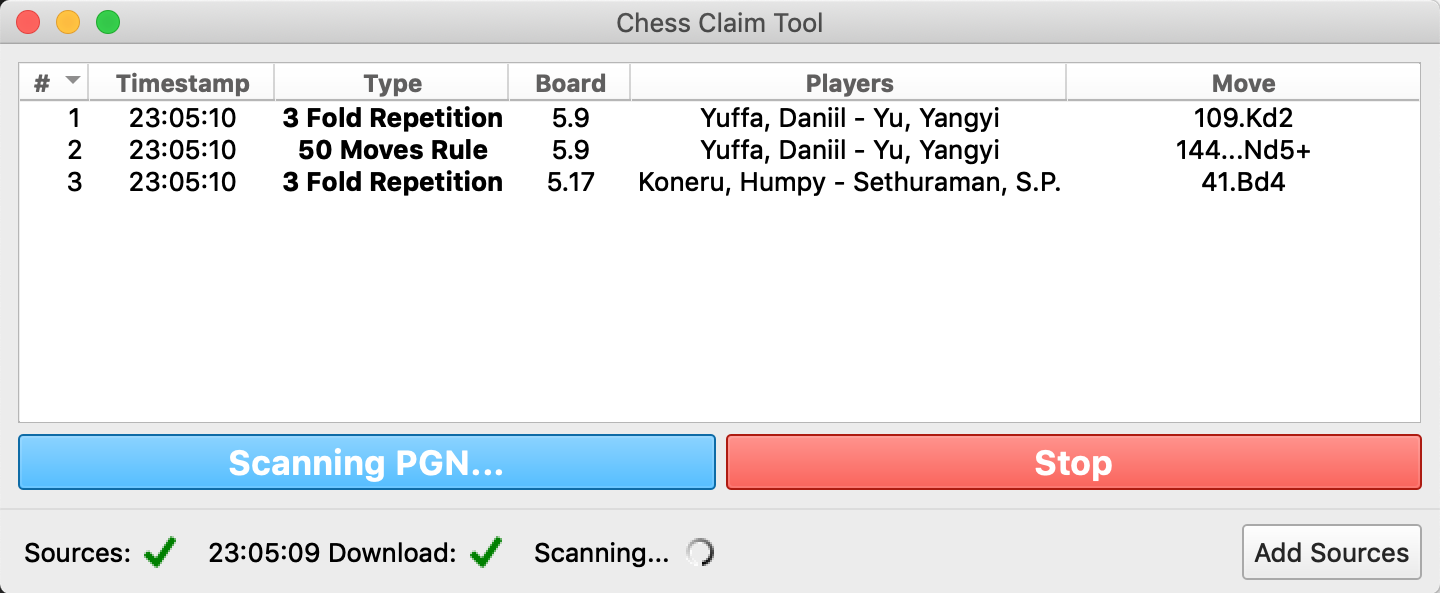
This can be pointed to a specific .pgn file and it will display and notify of any suitable chess claims that may arise.